
Water · Treatment & Resource Recovery
Cost Center to
Profit Center.
Produced water is the largest waste stream in oil & gas — and the most undervalued asset on your balance sheet. XRF-FI's nanobubble-enhanced MBC platform converts a pure cost center into a revenue-generating circular economy: cleaner water, lower cost, higher resource recovery.
01 / Full Process Diagrams
Two proven routes. One platform.
Both the Hou DeBANG and Solvay processes run on the same MBC + nanobubble platform — select the route that fits your feed chemistry, available reagents, and target byproduct markets. Click either diagram to expand.
Soda Ash (Na₂CO₃)
Primary product — both routes
CaCl₂ Brine
Solvay byproduct — completion fluids
CaCO₃/MgCO₃ Solids
Hou DeBANG — sale or disposal
Treated Water
~900 m³/day reuse-ready effluent
The Opportunity
Turn your biggest cost center into a profit center.
Every barrel of produced water costs money to handle — trucking, disposal, SWD injection, regulatory compliance. XRF-FI's platform flips that equation: the same water that was a liability becomes feedstock for soda ash, calcium chloride, and reusable frac water.
Before — Cost Center
- ✕SWD injection: $0.50–$2.00/bbl
- ✕Trucking & transport: $1.50–$4.00/bbl
- ✕Freshwater purchase for frac: $0.50–$2.00/bbl
- ✕Regulatory compliance & liability
- ✕Scale, corrosion & equipment damage
After — Profit Center
- ✓Soda ash (Na₂CO₃): ~$160 tons/day from 1,000 m³/day feed
- ✓CaCl₂ brine (Solvay): 9.5–11.6 lb/gal completion fluid
- ✓CaCO₃/MgCO₃ solids (Hou DeBANG): sale or disposal
- ✓~900 m³/day treated water for reuse (irrigation, industrial)
- ✓CO₂ recycled from calcination back to nanobubble generator
KEY BENEFITS
Uses nanobubbles to maximize gas-liquid contacting and reaction efficiency
MBC-1 purifies produced water before chemistry — protecting downstream equipment
Recycles CO₂ and magnetic polymer to lower operating cost
Smaller footprint and lower cost vs. conventional evaporation/thermal systems
Converts dissolved NaCl directly to soda ash via CO₂ nanobubbles — no ammonia required
Precipitates and removes hardness (Ca, Mg), reducing scaling and disposal issues
MBC-2 captures fine NaHCO₃ solids, reducing need for large crystals and filters
Recycles CO₂, NH₃, and magnetite — >90% ammonia recovery efficiency
Illustrative Mass Balance — Hou DeBANG
| Stream | Flow | Key Constituents | Notes |
|---|---|---|---|
| Feed Produced Water | 1,000 m³/day | NaCl, Ca²⁺, Mg²⁺, oil, solids | Typical high-TDS produced water |
| Soda Ash Product | ~160 tons/day | ~95% Na₂CO₃ | ≈160 tons/day theoretical from 60,000 mg/L NaCl |
| CaCO₃/MgCO₃ Solids | ~50–100 tons/day | CaCO₃, MgCO₃ | Varies with feed chemistry |
| Treated Water | ~900 m³/day | Low TDS (<1,000 mg/L) | For agricultural or industrial reuse |
| CO₂ Recycle | — | CO₂ gas | Recycled to nanobubble generator from calcination |
Based on 1,000 m³/day produced water at 100,000 mg/L TDS, ~60,000 mg/L NaCl. Values are illustrative and will vary with feed composition, recovery efficiency, and final product specifications.
02 / Platform Overview
A field-ready water factory at the point of origin.
On-Site Frac-Water Reuse
Condition flowback and produced brine by eliminating suspended solids, free oil, and multivalent scale-formers. Frac-water reuse maintains compatible salinity for fracturing fluid blending without requiring freshwater desalination.
Soda Ash Production (Both Routes)
Convert dissolved NaCl into commercial-grade sodium carbonate (Na₂CO₃) — soda ash — via CO₂ nanobubble contacting (Hou DeBANG) or NH₃ + CO₂ nanobubble contacting (Solvay). No membranes, no thermal evaporators.
Valuable Byproducts
Hou DeBANG co-precipitates CaCO₃/MgCO₃ hardness solids for sale or disposal. Solvay generates heavy CaCl₂ brine (9.5–11.6 lb/gal) for oilfield completion and workover fluids — directly offsetting procurement costs.
Treated Water for Beneficial Reuse
Both routes produce significantly reduced-TDS effluent with low hardness and scaling tendency — meeting reuse criteria for agricultural irrigation, dust control, and industrial applications.
03 / Process Architecture
Dual-route water management & chemical recovery.
High TDS (NaCl, Ca²⁺, Mg²⁺), oil & grease, suspended solids, dissolved gases, metals (Fe, Ba, Sr), organics/scale formers
Add magnetic polymer composite (MBC) · remove oil, solids, metals, hydrocarbons · coagulation/adsorption · magnetic separation → concentrated solids to disposal
pH adjustment · remove hardness (Ca²⁺, Mg²⁺) · temperature control · final filtration as needed
Chemistry adjustment → operator spec verification → immediate on-site reuse
Polished brine → nanobubble reaction train (Hou DeBANG or Solvay)
Generate CO₂ nanobubbles · high mass transfer · controlled pH 8.5–9.5 · convert NaCl to Na₂CO₃ · precipitate CaCO₃/MgCO₃ · CO₂ recycled from calcination
NH₃ nanobubble ammoniation → CO₂ carbonation → NaHCO₃ slurry · NH₃ recycled (>90%) · CaCl₂ byproduct
Allow crystal growth · optimize pH and mixing · precipitate Na₂CO₃ (Hou DeBANG) or NaHCO₃ (Solvay) · residence time control
Separate Na₂CO₃ / NaHCO₃ solids · remove CaCO₃/MgCO₃ · magnetic polymer for fine capture · magnetic separation + filtration
Wash & dewater solids · dry (rotary or fluid-bed) · commercial-grade Na₂CO₃ · optional calcination (C-401, 150–200°C) to soda ash · CO₂ recycled
Hou DeBANG: CaCO₃/MgCO₃ solids → sale or disposal · Solvay: NH₃ recovery unit → CaCl₂ brine for completion fluids
pH balance, trace residual oxidation & degasification
Complies with crop-specific EC, SAR, chloride, and boron limits
Automated diversion prevents off-spec land application
04 / Upstream Clarification
Stage 2: Magnetic Ballast Clarification (MBC).
MBC injects fine magnetite ballast into chemical micro-flocs, accelerating settling velocity up to 30× over conventional clarifiers. Magnetized rotating discs continuously pull flocs out of solution without filters or settling basins.
| Parameter / Feature | Specification / Metric | Operational Scope & Basis |
|---|---|---|
| Clarification Performance | ≥95% Turbidity, Solids & Oil Removal | Single-pass disc separation on raw produced water |
| Operating Characteristic | Non-Fouling | Continuous self-cleaning discs; no media backwashing |
| Direct Operating Cost | $0.03 – $0.05 / bbl | Magnetite makeup, polymer dosing & electrical consumption |
| Standard Unit Flow Rate | 500 GPM (~17,000 bbl/day) | Scalable from 50 to 2,000+ GPM in parallel trains |
| Physical Dimensions | 5′ × 5′ × 7′ High | Compact skid/trailer mobile footprint (weight ~1,200–1,500 lbs) |
| Connected Power | ~4 HP (3 kW) | VFD-controlled 230/460V 3-phase (single-phase compatible) |
| Magnetite Recovery | >99% Continuous Recovery | High-shear separation and magnetic drum scraper return |
| Startup / Shutdown | Instantaneous (<60 seconds) | Rapid cycle capability without biological lag or membrane prep |
05 / Reactive Gas Mass Transfer
Stage 3 & 4: Sub-micron nanobubble physics.
Conventional gas contactors suffer from rapid buoyant rise, limited interfacial contact area, and high atmospheric gas loss. XRF-FI utilizes reactive sub-micron nanobubbles (<1 μm / 1,000 nm) to maximize gas dissolution and accelerate chemical kinetics. The Solvay route uses two dedicated nanobubble generators in sequence (R-101 NH₃, then R-102 CO₂). The Hou DeBANG route uses a single CO₂ nanobubble generator (R-201).
Massive Interfacial Area
Trillions of sub-micron bubbles generate exponential surface area per unit volume, creating intense localized micro-reaction zones for rapid NaCl-to-Na₂CO₃ conversion.
Laplace Internal Pressure
Elevated internal bubble pressure (ΔP = 2γ/r) drives rapid gas dissolution into high-TDS brine without needing high-pressure reaction vessels.
Brownian Motion Stability
Negatively charged surfaces (zeta potential) prevent coalescence and eliminate buoyant rise, maintaining reactive gas in solution until ionic contact occurs.
Patent Protection (US 11,459,257 B1)
Covers treating liquids with reactive gas nanobubbles (ammonia, CO₂, ozone, etc.) and flocculation for salt and contaminant precipitation — protecting both the Hou DeBANG and Solvay implementations.
2. Carbonation Stage: NaCl + NH₃ + CO₂ (nanobubbles) + H₂O → NaHCO₃(s)↓ + NH₄Cl(aq)
06 / Engineered Reaction Train
Precipitation, maturation & mechanical separation.
After MBC-1 clarification and brine conditioning, the polished brine enters the reaction train. In the Hou DeBANG route, CO₂ nanobubbles (R-201) convert NaCl directly to Na₂CO₃ at controlled pH 8.5–9.5. In the Solvay route, NH₃ nanobubbles (R-101) ammoniate the brine, then CO₂ carbonation (R-102) precipitates NaHCO₃ for calcination to soda ash. MBC-2 (S-301) captures fine solids in both routes — eliminating the need for large crystals or conventional filters.
| Tag | Equipment Unit | Functional Role |
|---|---|---|
| T-101 (MBC-1) | MBC Separation & Brine Conditioning | Removes oil, solids, metals, hydrocarbons via magnetic polymer composite; coagulation/adsorption; magnetic disk separation; recycles magnetite |
| T-102 | Brine Conditioning Tank | pH adjustment; removes hardness (Ca²⁺, Mg²⁺); temperature control; final filtration as needed |
| R-201 (Hou DeBANG) / R-101 (Solvay) | Primary Nanobubble Contactor / Reactor | Hou DeBANG: CO₂ nanobubble generator, controlled pH 8.5–9.5, converts NaCl → Na₂CO₃, precipitates CaCO₃/MgCO₃. Solvay: NH₃ nanobubble contactor, closed-loop ammoniation, maximizes NH₃ absorption |
| R-102 (Solvay only) | CO₂ Nanobubble Reactor | Introduces CO₂ as nanobubbles for rapid gas-liquid transfer; controlled precipitation of NaHCO₃; temperature and pH/CO₂ dosing control |
| R-202 / R-103 | Maturation Tank | Allows crystal growth; optimizes pH and mixing; precipitates Na₂CO₃ (Hou DeBANG) or NaHCO₃ (Solvay); residence time control; gentle mixing |
| S-301 (MBC-2) | Solid-Liquid Separation (MBC-2) | Separates Na₂CO₃ or NaHCO₃ solids; removes CaCO₃/MgCO₃; uses magnetic polymer for fine capture; magnetic disk separation + filtration (clarifier, filter press); recycles magnetite |
| D-401 | Dryer / Calcination Prep | Washes and dewaters solids; dries (rotary or fluid-bed); produces commercial-grade Na₂CO₃; optional crystallization to desired purity (light or dense soda ash) |
| C-401 (Optional) | Calciner (150–200°C) | Heats NaHCO₃ → Na₂CO₃ + CO₂ + H₂O; captures and recycles CO₂ back to nanobubble generator; product cooling and handling |
07 / Recovery Routes & Byproduct Monetization
Hou DeBANG & Solvay — choose your chemistry.
Both routes produce commercial soda ash from produced water brine. Select the route that best fits your feed chemistry, available reagents, and target byproduct markets.
Hou DeBANG Process · CO₂ Nanobubble Conversion to Soda Ash
The Hou DeBANG process uses CO₂ nanobubbles (R-201) to directly convert dissolved NaCl in produced water brine into sodium carbonate (Na₂CO₃ — soda ash). Key reaction chemistry: (1) CO₂ dissolution enhanced by nanobubbles: CO₂(g) → CO₂(aq) ⇌ H₂CO₃; (2) Bicarbonate formation: CO₂ + H₂O ⇌ H⁺ + HCO₃⁻; (3) Sodium carbonate formation: 2 NaCl + CO₂ + H₂O → Na₂CO₃(s) + 2 HCl (removed in brine); (4) Hardness co-benefit: Ca²⁺ + CO₃²⁻ → CaCO₃(s); Mg²⁺ + CO₃²⁻ → MgCO₃(s). CO₂ is recycled from the calcination stage back to the nanobubble generator, minimizing reagent consumption. No ammonia required.
Sodium Carbonate (Na₂CO₃) — Soda Ash
Primary product of both routes. Precipitated NaHCO₃ is thermally calcined (150–200°C) into dense soda ash for glass manufacturing, detergents, water treatment, and drilling fluid conditioning. CO₂ released during calcination is recycled back to the nanobubble generator.
Calcium/Magnesium Solids (Hou DeBANG)
CaCO₃ and MgCO₃ co-precipitate as a hardness removal benefit. Separated by MBC-2 and sold or disposed of, while simultaneously reducing scaling potential in downstream equipment.
Calcium Chloride Brine (Solvay)
Heavy CaCl₂ brine from the NH₃ recovery cycle provides clear, solids-free completion fluids (9.5–11.6 lb/gal), directly offsetting commercial brine procurement costs for oilfield workover and completion operations.
Treated Water Effluent (Both Routes)
Significantly reduced TDS, low hardness, meets reuse criteria for agricultural irrigation, dust control, or industrial use. Hou DeBANG targets ~900 m³/day treated water from 1,000 m³/day feed at 100,000 mg/L TDS.
08 / Environmental Release Controls
Non-potable irrigation qualification gate.
Treated water effluent from both routes must pass agronomic qualification before any irrigation release.
| Agronomic Parameter | FAO / Target Limit | Agricultural Impact |
|---|---|---|
| Salinity (Electrical Conductivity, EC) | < 0.7 – 3.0 dS/m | Protects crop root osmotic balance and prevents soil salinization |
| Sodium Adsorption Ratio (SAR) | < 3.0 – 9.0 (correlated to EC) | Maintains soil permeability and prevents structural clay dispersion |
| Chloride Concentration | < 4.0 – 10.0 meq/L | Prevents foliar burn and leaf-tissue toxicity in sensitive crops |
| Boron Concentration | < 0.7 – 2.0 mg/L | Eliminates plant toxicity while providing essential micro-nutrients |
| Residual Ammonia / Organics | Non-detect / Permitted Levels | Ensures complete reagent stripping and biological safety |
08 / Resource Recovery & Tonnage Engineering Model
Production water constituent extraction & byproduct economics.
Engineered mass-balance model based on produced water chemical analysis, converting ionic constituents into marketable soda ash and byproducts via reactive nanobubble Hou DeBANG / Solvay processing.
| Extracted Constituent / Commodity | Feed Tonnage (ton/day) | Market Value ($/ton) | Daily Product Value ($/day) | Value per Barrel ($/bbl) |
|---|---|---|---|---|
| Recovered Fresh / Frac Water Equivalent | 0.0 ton/day | Water Reuse Credit | $0.00 | $0.00 / bbl |
| Sodium Bicarbonate / Soda Ash (Na₂CO₃) | 0.0 ton/day | $0.00 / ton | $0.00 | $0.00 / bbl |
| Ammonium Chloride Fertilizer (NH₄Cl) | 0.0 ton/day | $380.00 / ton | $0.00 | $0.00 / bbl |
| Less: NH₃ & CO₂ Reagent Input Cost | 0.0 ton/day | Reagent Makeup | ($0.00) | ($0.00 / bbl) |
| Avoided SWD Disposal Fee (Transport + Injection) | - | Disposal Offset | $0.00 | $0.00 / bbl |
09 / Overall Project Economics
Interactive site economics model.
Model field operating costs, byproduct revenues, and avoided SWD disposal fees across custom throughput scenarios.
Model reflects entered operational assumptions. Byproduct revenues and avoided disposal costs vary by basin and local market offtake.
10 / Field Equipment & Dewatering
Field equipment & single-pass clarity.
Operational demonstration units showing compact truck-mounted footprint, rapid solids extraction, and continuous cake dewatering.
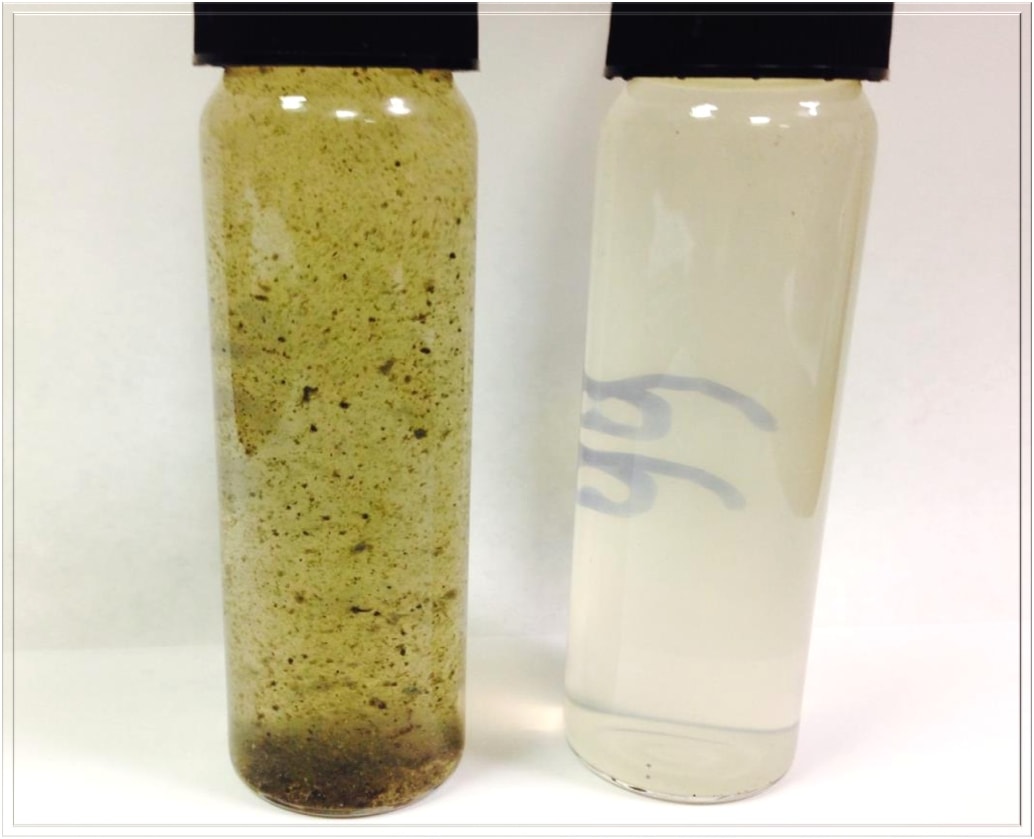
Oil & Gas Produced Water: Before and After
Laboratory field demonstration showing raw oilfield produced water containing heavy suspended solids and hydrocarbons (left) transformed into crystal-clear brine (right) in a single MBC gravity pass.
Primary Clarification Technology
See High-Rate MBC In Action
Watch step-by-step flocculation of wastewater, magnetic disc extraction, and continuous magnetite recovery yielding crystal-clear effluent in a single gravity pass.
- ≥95% Removal: Suspended solids, turbidity, and free oil extracted in seconds.
- Non-Fouling: Continuous self-cleaning magnetic discs — zero filter blinding.
- Ultra-Low Cost: $0.03–$0.05/bbl direct operating cost (magnetite, polymer & power).
- >99% Magnetite Recovery: Continuous high-shear magnetic drum ballast recycling.
12 / Intellectual Property
US Patent 11,459,257 B1.
The nanobubble treatment method underlying both the Hou DeBANG and Solvay recovery routes is protected by US Patent 11,459,257 B1, granted October 4, 2022, inventor Robert W. Troy.
| Claim Category | Patent Claims & Technical Scope |
|---|---|
| Independent Claims 1 & 20 | Creating nanobubbles of a gas comprising ammonia, flocculating, reacting with salt target components, and forming precipitate and treated liquid (uncharged and charged nanobubbles). |
| Claims 4 – 8 | Upstream filtration, shakers, hydrocyclones, and downstream precipitate/floc separation. |
| Claim 10 | Refinement achieving at least 95% turbidity removal. |
| Claims 11 – 15 | Polyaluminum chloride, polymers, ferromagnetic ballast material (magnetite), and magnetic recovery. |
| Claims 18 – 19 | Removal and precipitation of monovalent (NaCl) and divalent salts. |
13 / Get Started
Talk to our water team.
Ready to evaluate your produced water for MBC clarification, Hou DeBANG, or Solvay resource recovery? Contact us for a site-specific feasibility assessment.